Family Compounds In Florida: The New American Dream

Weatherford Realty Group

Family compounds are gaining renewed attention as thousands of families consider living close together again—but not under the same roof.

Instead of sharing one house, these properties give parents, adult children, grandparents and grandchildren the opportunity to live nearby while maintaining separate homes, private spaces and independent lives.

For families balancing rising housing costs, childcare needs and concerns about aging parents, the idea offers a practical way to share the responsibilities of life without sacrificing personal space.

Family Compounds: A Deep Dive

But what does it actually take to turn that idea into a workable family compound? From determining how much land is needed to navigating zoning, ownership, construction costs and a layout that preserves everyone’s privacy, the decisions begin long before anyone moves in. Here is how family compounds work, what they can look like and what families should know before buying or building one.

What Is a Family Compound?

A family compound is a property where multiple members or generations of one family live in separate residences located on the same parcel or on adjoining parcels.

There is no single required layout. Family compounds can include:

family compounds for sale in florida
  • One main house with a detached guesthouse
  • Two or more complete homes on one parcel
  • A primary residence with one or more accessory dwelling units
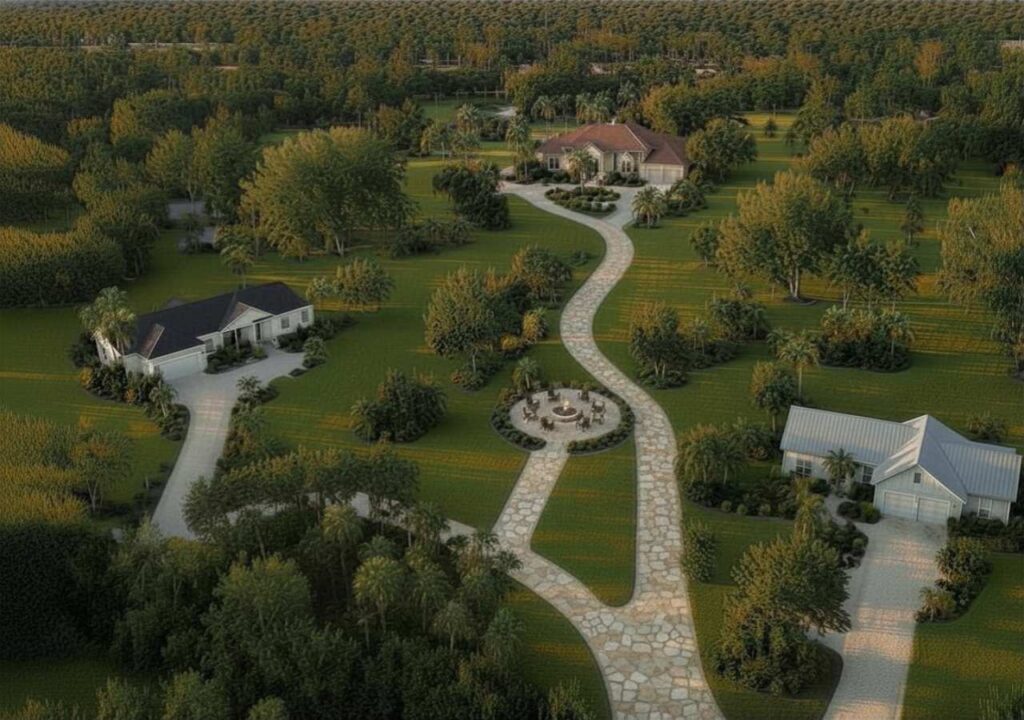
  • Several homes constructed around a shared outdoor space
  • Adjoining properties purchased by different family members
  • A rural estate with a main residence, caretaker’s cottage and additional dwelling
  • A large home divided into independent living quarters
  • Acreage reserved for homes to be added as the family grows

The difference between family compounds and ordinary multigenerational homes is usually the degree of independence it provides. Rather than placing everyone under one roof, a well-designed compound gives each household its own front door, kitchen, bathroom, living space and daily routine.

Everyone is nearby, but no one has to explain why they are making a sandwich at midnight.

Why Are Family Compounds Becoming So Popular?

Family Compounds in SW Florida

The renewed interest in family compounds is not being driven by one generation or one financial concern. It reflects several major changes happening at the same time.

Pew Research Center reported that 59 million Americans—18% of the U.S. population—lived in multigenerational households in 2021. Among adults between the ages of 25 and 34, the percentage living in multigenerational households increased from 9% in 1971 to 25% in 2021.

Housing costs are part of the explanation, but they are not the entire story.

Parents are living longer and often want to age near family without giving up their independence. Adult children may have good jobs and stable incomes but still struggle to purchase their first homes. Working parents are paying heavily for childcare while grandparents may live too far away to participate regularly in their grandchildren’s lives.

A family compound can bring those needs together in one place.

Families may be able to share certain expenses, divide property maintenance, help with childcare and remain available when an older relative needs assistance. At the same time, separate residences can preserve the privacy that is often missing in a traditional multigenerational household.

The goal is not to recreate a crowded house. It is to create a small family community. It’s a very attractive family goal, and larger properties are not lasting long in today’s market because of the increased interest. 

How to Start a Family Compound

Family Compounds in SW Florida

The first step in starting a family compound is not purchasing land. It is determining what the family actually wants to create.

A couple who wants a small cottage for an aging parent has very different needs from three adult siblings planning to build separate homes for their families. Before looking at properties, the family should determine:

  • How many households will live on the property now
  • Whether additional relatives may join later
  • How much privacy each household expects
  • Whether the homes will be owned collectively or separately
  • How expenses and property maintenance will be divided
  • Whether anyone intends to operate a business, keep animals or store equipment
  • Whether any residence may eventually be rented
  • How the property should pass to the next generation
  • What happens if someone wants or needs to leave

This conversation needs to go beyond bedroom counts.

One family member may picture Sunday dinners and grandchildren running freely between houses. Another may picture private acreage where relatives happen to live within walking distance. Neither vision is necessarily wrong, but those expectations must be reconciled before anyone signs a contract.

Once the family has an agreed-upon vision, it can determine whether to buy an existing compound, purchase a property with expansion potential or build the entire compound from the ground up.

Family Compound Ideas for Different Families

Family Compounds in SW Florida

The best family compound ideas begin with the people who will live there. A beautiful layout that ignores privacy, accessibility or future needs can become frustrating very quickly.

A main home with a separate cottage

This is one of the simplest configurations. The larger home may accommodate a family with children, while a detached cottage provides an independent residence for a parent or grandparent.

Two full-size homes on acreage

Two independent residences can work well for adult siblings, parents and adult children, or two related families purchasing together.

A central home with several smaller residences

A primary gathering house near the center of the property with smaller homes arranged around it. The central house may contain the largest kitchen, dining area, pool or outdoor space.

Adjoining homes on separate parcels

Not every compound has to sit on one legal parcel. Purchasing neighboring homes or adjacent lots may provide many of the same benefits while allowing each household to own and finance its property separately. This arrangement may also offer a clearer exit strategy if one family member eventually wants to sell.

A phased family compound

A family may begin with one existing house and enough legally buildable land for future residences. A cottage could be added for a parent, followed later by a home for an adult child. Phased construction can spread expenses over time, but the complete plan should be evaluated before the original property is purchased.

A working family homestead

Some families want more than residences. Their plans may include gardens, livestock, workshops, barns, equipment storage or a family business. For these buyers, agricultural or rural property may offer the space and allowable uses needed to create both a residential compound and a productive working property.

Family Compound Layout Plans: How Close Is Too Close?

The most successful family compound layout plans create intentional opportunities for connection without making anyone feel watched.

Placing every home in a tight circle may look charming on paper—until one household realizes that every porch, bedroom window and parking space faces another relative’s house.

A thoughtful layout considers:

  • The distance between residences
  • The direction of windows and porches
  • Natural barriers such as trees and landscaping
  • Separate parking areas
  • Vehicle and pedestrian traffic
  • Private outdoor areas
  • Shared recreational spaces
  • Noise from children, pets, workshops or equipment
  • Accessibility for older family members
  • Emergency vehicle access
  • Drainage, flood exposure and elevation
  • Septic systems, drainfields, wells and utility lines

Shared spaces can include a pool, pavilion, outdoor kitchen, playground, garden, barn, firepit or workshop. These areas give the family places to gather without requiring one household to host everyone inside its private home.

The individual residences should still function independently. Each household should ideally have its own entrance, kitchen, bathroom, laundry facilities, living area, parking and outdoor space.

The best test of a layout is simple: Can everyone be together when they want to be and alone when they need to be?

How Much Land Do You Need for a Family Compound?

There is no universal acreage requirement for family compounds. How much land you need depends on local zoning, the number and size of the residences, the property’s infrastructure and the amount of separation the family wants.

Two homes may fit comfortably on a relatively small parcel if public water and sewer are available and local density rules allow both residences. A rural property using private wells and septic systems may require considerably more space because each home needs room for infrastructure, setbacks and drainage.

The number of acres shown in a listing does not establish how many homes can legally be built.

A property’s development potential may be affected by:

  • Zoning designation
  • Future land-use designation
  • Permitted residential density
  • Minimum lot size
  • Building setbacks
  • Wetlands and protected areas
  • Flood zones
  • Road frontage and legal access
  • Well and septic requirements
  • Easements
  • Deed restrictions
  • Homeowners’ association rules
  • Existing buildings and improvements

Before purchasing land, the proposed number and type of residences should be reviewed with the appropriate county or municipal departments. This is also where working with an experienced real estate broker becomes especially important. A broker who understands acreage, zoning and multi-residence properties can help identify potential restrictions, uncover questions that need to be answered during due diligence and coordinate the appropriate surveys, environmental reviews, soil evaluations or site plans. The goal is not simply to find enough land—it is to find land that can legally and practically support the family compound you intend to create.

How to Build a Family Compound

Learning how to build a family compound begins with determining whether the plan is permitted on the selected property.

Florida does not have one statewide rule allowing multiple homes on every residential parcel. Local governments control many of the zoning, density and development requirements that determine what can be built.

Florida law defines an accessory dwelling unit as a secondary living unit with its own kitchen, bathroom and sleeping area located within the primary structure or on the same lot. However, state law allows local governments to adopt ordinances permitting accessory dwelling units; it does not automatically permit them on every Florida property.

Before construction begins, families may need to work with:

  • A land-use or zoning professional
  • A surveyor
  • A civil engineer
  • An architect or residential designer
  • A licensed general contractor
  • Well and septic professionals
  • The local building and planning departments
  • A Florida real estate attorney
  • An insurance professional
  • A lender familiar with multi-residence properties

The infrastructure should be planned for the entire compound, even if the homes will be built in phases. Driveways, utility service, drainage, wells, septic systems and emergency access can become much more expensive to change after the first residence is positioned.

Accessibility should also be considered from the beginning. A home intended for aging parents may need a step-free entrance, wider doorways, an accessible bathroom and a floor plan that can continue working if mobility changes.

What Should Buyers Look for in Family Compounds for Sale?

get more buyers

Family Compounds in SW Florida

Buyers searching for family compounds for sale should evaluate the legality and functionality of every residence.

Important questions include:

  • How many legal dwelling units are on the property?
  • Were all residences and additions properly permitted?
  • Does each home have a certificate of occupancy?
  • Are the residences separately metered?
  • Are the homes connected to public utilities or private systems?
  • Can the septic and water systems support the current occupancy?
  • Are any buildings located in a flood zone?
  • Are there shared driveways or access easements?
  • Can additional residences be constructed?
  • Can the parcel be divided?
  • Are there rental restrictions?
  • Can every structure be properly insured?
  • How will the property be financed?

A structure described as a guesthouse may not legally qualify as an independent residence. A converted barn, garage apartment or detached suite may look complete while lacking required permits or approvals.

The listing description is a starting point—not legal confirmation of how the property may be used.

Finding Family Compounds for Sale in Florida

Finding family compounds for sale in Florida can be difficult because “family compound” is not a standard property category used for every suitable listing.

Properties with compound potential may be advertised using terms such as:

  • Multigenerational property
  • Multi-home estate
  • Multiple residences
  • Two homes on one property
  • Main house with guesthouse
  • Detached in-law suite
  • Caretaker’s cottage
  • Private family estate
  • Equestrian estate
  • Agricultural property with multiple homes
  • Income-producing property
  • Adjacent homes or parcels

Florida buyers should pay particular attention to rural and semi-rural properties, where larger parcels and existing outbuildings may offer more possibilities. However, rural land still carries zoning, density, access, wetland and infrastructure restrictions.

An existing multi-home property may offer the most direct route, particularly if all residences are properly permitted and functional. Adjoining homes on separate parcels may provide another option for families that want proximity with clearer individual ownership.

Acreage in SW Florida

Check these listings to start your property search & create your own family compaund

No Results Found.

Have Questions? Contact Us Today!

Picture of Stephanie Diogo

Stephanie Diogo

Stephanie Diogo is a Labelle, Florida resident, real estate and business investor, and owner / broker with Weatherford Realty Group. Stephanie is an award-winning Realtor with over two decades of experience working with investors, first time home buyers and developers in SW Florida.

More Articles
Facebook
Twitter
LinkedIn

Have Questions? Contact Us Today!

Weatherford Realty Group is Here for You!

If you’re looking for today’s best real estate opportunities, you’ve come to the right place. 

Whether you’re thinking of relocating or searching for the ideal commercial property for sale, give us a call. Weatherford Realty Group has over two decades of experience working with buyers, sellers, land developers, investors and first time home buyers.
We are committed to being the best real estate agency in SW Florida.

Facebook
Twitter
LinkedIn
Skip to content